Asian Mile Challenge Series
2005 Launch
In 2005 the "Asian Mile Challenge" was started by the alliance of the Champions Mile (Hong Kong) and the Yasuda Kinen (Japan).
The Asian Mile Challenge is a series of four one-mile Thoroughbred horse races. Created in 2005, the series was launched with two races, one in Hong Kong, the other in Japan. In 2006, the Melbourne Racing Club of Australia and the Dubai Racing Club of the United Arab Emirates joined the series. (Wikipedia)
This was the official website.
Content is from the site's 2005 archived pages.
For more information about the Asian Racing Conference go to their current website at: www.asianracing.org/
For more information about the Hong Kong Jockey Club go to their current website at: www.hkjc.com/home/english/index.aspx
NEWS/ PRESS RELEASES
HKJC and JRA launch exciting Asian Mile Challenge series
19 March 2005
The Hong Kong Jockey Club and The Japan Racing Association have broken new ground with the launch of a unique Asian Mile Challenge.
The world's best milers are invited to contest in the two-part Asian Mile Challenge: the US$1.02 million Champions Mile (1600m) on May 14 at Sha Tin, and the US$2 million Yasuda Kinen (1600m) in Tokyo on June 5.
There will be a bonus of US$1 million available to the winner of both races - that's a total of over US$4 million up for grabs for this bold new initiative.
"Along with our friends at the JRA, we are very excited to take a leading role in the internationalisation of horse racing by establishing the Asian Mile Challenge. This joint venture is the latest development in a history of close co-operation between our organisations, but the real winners are the fans of top class international racing," said Mr Ronald Arculli, Chairman of the Hong Kong Jockey Club.
"As a result the Hong Kong Group One Champions Mile will now be open to international competition. We look forward to developing the Champions Mile into an International Group One event, bringing it to the highest level." Mr Arculli added.
To encourage horses to nominate for both races, horses nominated for the Champions Mile will automatically be nominated for the Yasuda Kinen also, unless the nominator declares otherwise. Free nominations close on Tuesday, April 26 at 12.00pm local time.
International breeding experts have long espoused the advantages of selecting stallions successful at the highest level of at a mile but now, through the co-operation of the HKJC and JRA, there is an opportunity to identify a champion miler in the Asian region.
Trainers and owners from around the world are invited to take up the challenge. Details are available at this website: www.asianmilechallenge.com.
The Asian Mile Challenge coincides with Japan-Hong Kong Year 2005 to mutually strengthen networks for co-operation in areas such as tourism, culture, economy and education.
Mr. Ronald Arculli, Chairman of the Hong Kong Jockey Club makes an exciting announcement on a significant development for international racing today at the Parade Ring at Sha Tin Racecourse. The Hong Kong Jockey Club and The Japan Racing Association have broken new ground with the launch of a unique Asian Mile Challenge. The world's best milers are invited to contest in the two-part Asian Mile Challenge: the Champions Mile on May 14 at Sha Tin, and the Yasuda Kinen in Tokyo on June 5.
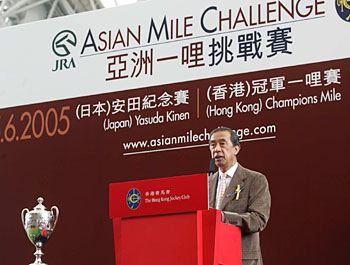
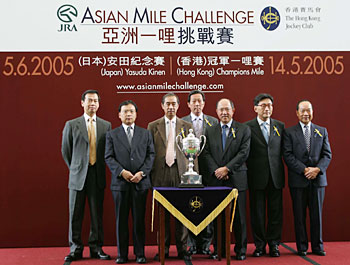
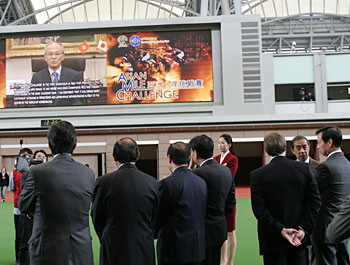


The Welcome by the Chairman, Mr. Ronald Arculli
I take great pride and pleasure to announce on behalf of the Stewards of the Hong Kong Jockey Club the inauguration of the Asian Challenge Mile consisting of the Hong Kong Group One Champions Mile on 14 May 2005 and the International Group One Yasuda Kinen run by the Japan Racing Association on 5 June 2005.
The close cooperation between the Hong Kong Jockey Club and the Japan Racing Association, both of which are members of the Asian Racing Federation a powerful and influential racing authority, has resulted in this important development.
The Japan Racing Association and the Hong Kong Jockey Club's shared passion for the internationalisation of the sport of horse racing was a major factor in launching the Asian Challenge Mile. We believe that increasing international competition in horse racing enables racing fans around the world to be part of great moments on the turf. This Challenge Mile will also give us the opportunity to watch great milers come together and compete at our premier racecourses.
This is a step forward for international racing, and a step forward for Asian racing. It also brings us closer towards inaugurating an Asian Racing Federation Mile Challenge on a broader scale in the near future.
Approximately US$4 million will be on offer for the two races, including a bonus of US$1 million for the owner of any horse which wins both legs of the Challenge.
As a result the Hong Kong Group One Champions Mile will now be open to international competition. We look forward to developing the Champions Mile into an International Group One event, bringing it to the highest level and on a par with the prestigious Yasuda Kinen.
Both of the Asian Challenge Mile races will be open to horses from any country around the world. I hope that owners and trainers will take up the challenge to compete in these two very special races.
Amongst a host of international victories, many of you will recall the excitement and glory of Fairy King Prawn's victory in the 2000 Yasuda Kinen and of Eishin Preston's victory in the 2001 Hong Kong Mile. I look forward to our runners from Hong Kong taking up the challenge in Japan again as well as welcoming international stars around the globe to Hong Kong in May.
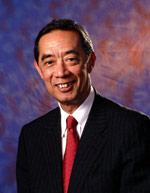

Mr. Ronald Arculli GBS JP Chairman / The Hong Kong Jockey Club

As long as I can remember my father has followed international horse racing. In 2007 he was in Australia for the start of the 2007 Asian Mile Challenge. He watched the second leg of the challenge that was held in Dubai from Hong Kong where he was living. The third leg was in Hong Kong so it was easy to attend. And then he flew to Tokyo, Japan that June for a business meeting which just happened to coincide with the fourth leg of the series, He was and still is a race horsing aficionado.
Jump ahead to 2021. My father has retired and after several falls that left him physically compromised, he now lives close by to me at an assisted living facility called Hart Heritage in Bel Air Maryland. I used to visit him weekly before the pandemic. Now that the facility has been able to have all residents and staff vaccinated, I am hoping that this spring I will be able to return to seeing him in person. In the meantime, we set up weekly Facetime meeting between us. I catch him up on all the recent horse racing news. I know he checks several websites including www.thoroughbrednews.com.au/ which covers not only international news, but also in depth news for Hong Kong and Australia, before speaking with me since he queries me about various races. Although the Asian Mile Challenge is no more, there are plenty of other international races to follow.
INTRODUCTION
Member countries within the Asian Racing Federation (ARF) generate 64% of the world's betting turnover on horses racing, breed 35% of the world's thoroughbreds and offer 51% of the world's thoroughbred prize money. The Asian Mile Challenge is the latest development in a history of close co-operation between the Hong Kong Jockey Club (HKJC) and the Japan Racing Association (JRA), both of which are members of the ARF.

In a unique initiative, these two prestigious racing organisations have combined to link their individual mile races. The HKJC Champions Mile and the JRA Yasuda Kinen are major mile championship races in their own countries. In a world first any horse that can win both of the prestigious races in 2005 will receive a US$1,000,000 bonus.
For many years the doyens of international breeding have espoused the advantages of selecting stallions who have been successful at the highest level at a mile. Through the co-operation of the HKJC and JRA, there is now an opportunity within the most important racing federation in the world to identify a champion miler.
The Yasuda Kinen has been open to international competition since 1993 while the Champions Mile will be open to international competition for the first time. Importantly, keeping with the internationalisation of racing, both races and the bonus prize are open to horses from anywhere in the world.
The challenge has been launched, the prize money is in place, we invite you to nominate your horse to secure your place in racing history on the turf at Sha Tin and Tokyo.
Are you up to the challenge?
5 June 2005
 |
 |
|
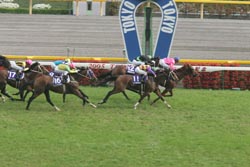
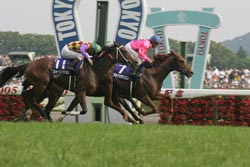
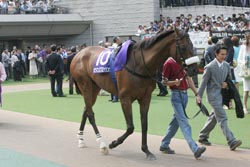
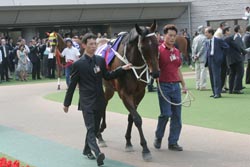
| Photo 1 & 2 Hong Kong representative Silent Witness (No.12) battles on well under Felix Coetzee to snatch a creditable third, a head behind runner-up Sweep Tosho (No. 11) in the 1600-metre Yasuda Kinen at Tokyo Racecourse today. Asakusa Den'en (No.7) wins the race in 1:32.3. |
||
 |
 |
|
 |
||
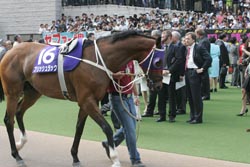
| Photo 3, 4 & 5 Bowman's Crossing (No.10), Silent Witness (No.12), Bullish Luck ( No.16), at the parade ring before the race. |
||
 |
||
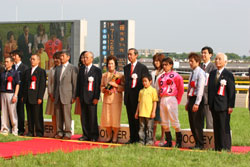
| Photo 6 Presentation ceremony of Yasuda Kinen on turf. |
||
NOMINATIONS & SELECTION
NOMINATIONS
- Nominations must be made before 12 noon local time on Tuesday 26 April 2005.
- There is no nomination fee.
- There will be no supplementary entries.
- Overseas nominations should be lodged as stipulated on the nomination form.
- The Hong Kong Jockey Club (HKJC) reserves the right to reject nominations at any time at its discretion whether or not they have been previously accepted.
SELECTION
Selection of the final field for the 2005 Champions Mile will be carried out through the following process:
- The International Panel of Senior Handicappers and Racing Officials will rank all overseas horses that have been nominated for the race. The Panel will advise the HKJC of their recommendations for selections and if necessary, reserves, in both national and international rank order, paying particular attention to each horse's past performances over the specific distance of the race.
- The HKJC, following advice from the Panel, has the sole authority and discretion in determining the line-up of the race, and the decision of the HKJC shall be final.
- The race is limited to 14 starters, with a maximum of 7 starters selected from the international entries.
- Selection of Hong Kong entries will be decided at the sole discretion of a Selection Panel comprising of the Executive Director of Racing and Head of Handicapping of the HKJC. Hong Kong horses would be expected to have performed satisfactorily at Group level.
- The HKJC has, as a selection priority, the overall quality of the fields for the race. The HKJC reserves the right, and has the sole authority to decide on the number of runners of the race, after careful consideration of any entry's overall standing and potential to perform adequately in the race. Therefore any entry, whether national or international, is not guaranteed selection even if the selections are less than the maximum 14 starters.
DECLARATION FEE
- For overseas owners, the declaration fee of HK$80,000 must be paid through their account with the nominated Racing Authorities as recognised by HKJC, or lodged in the account of the HKJC (bank details below) by no later than close of business (HK time) on Wednesday 11 May 2005, or paid by bank draft presented to the HKJC by 8.00 am (HK time) on Thursday 12 May 2005.
Beneficiary: THE HONG KONG JOCKEY CLUB Banker: HONGKONG & SHANGHAI BANKING CORP. LTD
1 QUEEN'S ROAD CENTRAL
HONG KONGAccount no.: 002-241354-001 Amount: HK$80,000
Owners are required to fax a copy of the telegraphic transfer remittance/requisition slip directly to the HKJC's International Racing Department (fax: (852) 2966 7000). All incoming payments and transfers must be accompanied by the following details: Name of Race, Name of Horse and Sender's Name.
- For Hong Kong owners, the same fee of HK$80,000 is levied and payable through the monthly membership account.
- 3. A declaration fee will be refunded only in the event a horse is certified not suitable to race by a HKJC veterinary surgeon in the Champions Mile to be run on Saturday 14 May 2005.
GENERAL CONDITIONS
- Nominations/entries and participation in the Champions Mile are subject to the Rules of Racing of the HKJC.
- The HKJC reserves the ultimate right without assigning a reason to accept or decline nominations/entries and in particular to reject a nomination/entry at any time whether or not it has been previously accepted.
- The Champions Mile is promoted by the HKJC in which all rights are vested and reserved, to the exclusion of all others, including:
a) the title;
b) all rights of sponsorship of and in connection with the race and the title;
c) all rights of broadcast and telecast, reproduction and transmission of and associated with the race and the title worldwide by any means whatsoever both by sound and vision for the full period of copyright and/or analogous rights subsisting under the laws of each jurisdiction throughout the world.
- All Owners, Trainers and Jockeys whilst in Hong Kong must:
a) be present at the official functions as invited by the HKJC;
b) make themselves available at all reasonable times (including immediately after the race) for interviews by the press and other representatives of the media when requested by the HKJC;
c) not carry advertising or sponsorship material other than as required or approved by the HKJC.
- The Stewards of the HKJC reserve the right to postpone or to abandon the race at their discretion.

HORSEMEN'S GUIDE
Champions Mile
HORSE SHIPMENT
1. The HKJC will arrange and cover the normal costs of return transport by road from the home stable to the departure airport, and return air transport for each selected overseas horse, based on existing cargo routes. Any change from the suggested transport arrangement by the HKJC which incurs additional costs will be at the owner's expense. The shipping arrangements of all horses will be organised by the HKJC and co-ordinated by the HKJC's appointed shipping agents. The HKJC and its transport agents will not be liable for any death of or injury to any invited horses during transportation to and from Hong Kong, or while in Hong Kong.
2. Horses from the same region will:
a) as far as possible, travel on the same flights;
b) need to share pallets on the basis of two horses for each pallet. Costs during the period spent in quarantine on return to the home country will be for the owner's account.
3. The HKJC's Champions Mile shipping agents are as follows :-
a) Australia / New Zealand / Singapore
New Zealand Bloodstock
Tel : 61 2 4655 8812
Fax : 61 2 4655 8872
b) Europe
BBA Shipping & Transport Ltd
Tel: 44 1638 665 021
Fax: 44 1638 669 273
c) North America
International Racehorse Transport
Tel: 1 630 262 1221
Fax: 1 630 262 1331
d) United Arab Emirates
Darley Stud Management Co. Ltd
Tel: 44(1638) 782 666
Fax: 44(1638) 782 667
e) Japan
Nosawa & Co. Ltd
Tel: 81 3 3216 3476
Fax: 81 3 3201 3039
4. The HKJC strongly recommends to ship horses at least ten days before the date of the race to allow recovery from any travel related problems and clearance from their systems of any therapeutic prohibited substances required to be administered. Such medications may be detected in samples taken from horses for much longer than a week.
5. All horses must travel with their passport and any other official identification papers which must be available for inspection and collection by the veterinary authorities upon their arrival at the isolation stables in Hong Kong. The documents will be endorsed and returned prior to the horses' departure from Hong Kong.
6. The HKJC will not be responsible for horse insurance. Connections should have their own insurance arrangements.
ASSISTANT TRAINERS, HEAD LADS, EXERCISE RIDERS & GROOMS
1. A maximum of two persons may travel at the HKJC's expense with each selected overseas horse, provided space is available on the cargo plane. If such persons are unable to travel with the horse, the HKJC will provide Economy Class air tickets, at the HKJC's discretion.
2. A maximum of two persons per horse will be provided accommodation at the officially appointed hotel in Sha Tin by the HKJC for the normal duration of the trip. Any extension of stay will not be covered by the HKJC. Transport will be provided to/from the hotel and the quarantine stables.
STABLING
1. The HKJC imports fodder from Australia, China, France, South Africa, the UK and the USA. Large selections of proprietary feeds are available.
2. Three types of bedding are available: wheat straw, newspaper strips and bedmax (wood shavings).
3. The stables' water supply is normal domestic drinking water. In addition, a sterilised/filtered water unit is installed in each stable block.
4. Importation of feed and water, subject to examination, is permitted within the limitation of aircraft space.
5. Dietary supplements may contain unknown prohibited substances and all are used at the trainer's own risk. Common supplements currently used by trainers at the HKJC will be made available to visiting trainers, on request.
INSURANCE
1. ALL visiting horse connections (owners, trainers, assistant trainers, head grooms and grooms) are strongly recommended to arrange their own insurance to cover travel, work and non-work related injury and illness.
2. ALL visiting jockeys will be covered for medical and personal accident under the HKJC's insurance policy upon licensing for injury arising out of their occupation within the HKJC's premises. As licensing does not cover jockey's liability insurance, this will be arranged in addition and jockeys will be required to pay the premium for the coverage.
LICENSING
Licences for visiting trainers and jockeys will be issued on arrival. Visiting jockeys are required to arrive in Hong Kong at least one day prior to the race day. A jockey's licence will permit the holder to accept offers to ride in all races at Sha Tin at the Champions Mile race meeting.
ADVERTISEMENTS & SPONSORSHIP MATERIALS
Unless otherwise approved by the Stewards of the HKJC, no licensed person or member of the stable staff shall wear any item of clothing displaying any advertising material. Only jodhpurs approved by the HKJC may be worn by riders in races.
PRE-RACE MEETING
Overseas jockeys are required to attend a meeting with the Race Meeting Stewards before the first race on the day in the Inquiry Room at Sha Tin Racecourse.
APPRENTICES
No apprentice allowance may be claimed. Furthermore, an apprentice who is entitled to claim an allowance of 10 lbs will not be permitted to ride in these races.
BODY PROTECTOR
All jockeys and track work riders are required to wear a body protector of a design approved by the Stewards of the HKJC. Jockeys are entitled to a one pound allowance for the body protector at the scales.
TESTING OF JOCKEYS
1. The HKJC requires the random selection of several jockeys per race day to take and pass a breathalyser test for alcohol and a urine test for prohibited substances. All jockeys are therefore required to be in the Jockeys Room, Sha Tin Racecourse at least one hour before the first race.
EQUIPMENT
Whips & Spurs
All whips used in races and in training must be of a design which complies with the requirements of the Stewards. No spurs may be worn in races.
Nasal Dilators, Dropped Nosebands, "Deafeners" (Ear Plugs) and Other Unspecified Equipment
Nasal dilators, dropped nosebands and "deafeners" (ear plugs) are not permitted to be used on horses racing in Hong Kong. Any other unspecified equipment may not be fitted to a runner without prior permission of the HKJC's Head of Veterinary Regulation & International Liaison or the Stewards.
Bandages
Trainers must ensure that bandages fitted to horses' legs are securely fastened for both racing and training.
Blinkers, Hoods, Pacifiers, Visors, Shadow Rolls and Tongue Ties
Blinkers, hoods, pacifiers, visors, shadow rolls and tongue ties must be registered on the declaration form and submitted before declarations close at 8:00 am on Thursday 12 May 2005, i.e. two day declaration.
The equipment with which a horse starts a race shall be worn throughout such race by the horse and is not permitted to be removed. Horses must start wearing the equipment that they parade in.
TRACK & WEATHER CONDITION
Horses run right-handed on an oval flat turf 30.5 metres wide with a 430 metres (a little over 2 furlongs) homestretch.
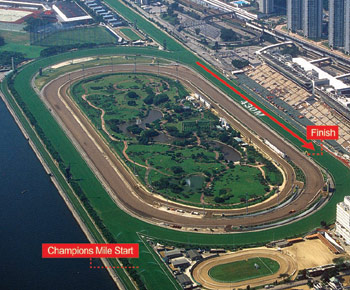
The weather in May in Hong Kong is usually humid with temperatures averaging 24°C (75°F) to 28°C (82°F).
VETERINARY & RACING PROTOCOLS
CRITICAL DATES
- During the 90 days pre-export of the horse to Hong Kong (but not within 14 days) either commence a primary course of equine influenza vaccinations or administer a booster dose to a primary course.
- During the 14 days pre-export of the horse to Hong Kong specific disease testing to be performed.
- At least 7 days pre-export of horse to Hong Kong submit first medication list to HKJC.
- Between 3 and 6 days pre-export of horse to Hong Kong pre-travel veterinary inspection and provide inspecting veterinarian with an updated medication list.
- All medications administered to the horse after the veterinary inspection until its arrival in Hong Kong to be reported in writing to the HKJC.
NB - See the rest of this document for provisions relating to vaccinations and disease testing involving multi-country travel.
PRE AND POST-TRAVEL INSPECTION, HEALTH PROCEDURES, MEDICATION AND TESTING
-
The equine health protocols for the temporary importation into Hong Kong of registered racehorses for international races have been revised largely in accordance with the recommendations made in the "Guidelines to Facilitate the Temporary Movement of Registered Racehorses for International Races" issued by the International Federation of Horse Racing Authorities (IFHA). Specific equine importation information is available at the Hong Kong Government website:
Further information may be obtained from:
Dr Keith L Watkins BVSc MRCVS
Head of Veterinary Regulation & International Liaison
Department of Veterinary Regulation & International Liaison
The Hong Kong Jockey Club
Sha Tin Racecourse, New Territories
Hong Kong SAR, China
Tel: (+852) 2966 6608
Fax: (+852) 2602 3305
and/or the Club's horse shipping agents in each country.
It is essential that, prior to embarking on any journey, the racehorse's connections make appropriate enquiries of the veterinary authorities of all countries to be visited, including the country of final destination, to ensure that they have fulfilled all their equine import requirements. - It is strongly recommended that every invited horse has a thorough veterinary clinical examination (including blood tests and endoscopy), performed by its usual veterinary surgeon, prior to travelling to Hong Kong, to ensure that it is fit and healthy to embark on very long road and air journeys and to reduce the risks of the horse being affected by "travel sickness". A mild clinical or sub-clinical respiratory infection will undoubtedly be exacerbated by travel and could jeopardise a horse's chance of competing in the race and adversely affect its future health.
- All invited horses will be subject to a stringent pre-travel veterinary inspection by the HKJC's appointed veterinary surgeons before their departure to Hong Kong, from whichever country they may be in at this time. The purpose of this inspection is to ensure that the horse is not suffering from any obvious problems, which could possibly:
• jeopardise its chances of competing in its race
• have an adverse effect on its performance in its race
• cause it to finish lame or "break down" during the race
• adversely affect its health during travel
The inspection will (inter alia) require the horse to be trotted-up in-hand on a firm flat surface and undergo palpation of its locomotor structures.
- A Pre-travel Elective Testing Service is available through the HKJC to assist the connections of horses to determine whether or not their horses are free of previously administered therapeutic medications. Please note that this is an advisory service only, the official samples are those collected in Hong Kong. Details of this service may be obtained from the HKJC's HVR&IL.
- Upon arrival at the isolation stables in Hong Kong, all horses will be required to submit blood and urine samples for analysis for prohibited substances. Any sample reported positive to any prohibited substance as a result of this test and which is not consistent with the information declared either in the pre-import medication lists, or for treatments necessarily administered during travel, and which were declared in writing immediately upon the horse's arrival in Hong Kong, may be withdrawn at the absolute discretion of the Stewards any time prior to racing. If the horse is withdrawn under these circumstances, the travel subsidy and declaration fee may be forfeited at the discretion of the Stewards of the Club.
- All racehorses in Hong Kong are required to pass an official pre-race veterinary inspection the day before they race. This inspection will be held after track work on Saturday preceding Raceday.
VACCINATION AND QUARANTINE
- Certified documentary evidence of all vaccinations that have been administered to the horse must be available for inspection by the HKJC and Government Officials.
- Visiting horses will be allocated specific isolation stables, training times and places, and all notices and instructions (written and verbal) issued by HKJC and Government officials relating to these matters must be strictly complied with. Since all overseas racehorses, which are temporarily visiting Hong Kong, will be of equivalent health status, they shall, unless otherwise advised, be permitted to use the training tracks at the same time as each other, but at different times to local horses. Access to the isolation units is strictly restricted to authorised persons only and all such persons must be registered with the Club's Security Department.
MEDICATION AND PROHIBITED SUBSTANCES
- The Rules of Racing of the HKJC are based upon prohibited substances free participation and, therefore, all racehorses in Hong Kong are tested pre-race for such substances. Selected horses will also be tested post-race.
- The Rules state: "The Stewards shall have the power to withdraw at their discretion any declared runner if a pre-race test taken from such horse is reported by the Chief Racing Chemist or other chemist authorised by him as positive or potentially positive for the presence of any prohibited substance."
- The trainer may also be punished according to the Rules of Racing if a horse, which was declared to start in a race, is found to have received a prohibited substance.
- Whilst in Hong Kong no treatment of any sort may be given to any racehorse without prior permission from an Official Veterinary Surgeon of the HKJC and a HKJC Veterinary Surgeon may only administer all treatments. If in doubt about treatment of any sort, the horse's trainer, or his authorised representative should contact one of the HKJC's Veterinary Surgeons.
- It must be noted that any person providing veterinary services in Hong Kong must, as a statutory requirement, under the Veterinary Surgeons Registration Ordinance, be registered with the Veterinary Surgeons Board of Hong Kong. To obtain such registration may take several weeks. Should a horse's connections anticipate that they may require the services of their own, or a specialist veterinary surgeon, then application to the Veterinary Surgeons Board of Hong Kong must be made at least four (4) weeks prior to such services being required. The HKJC's HVR&IL will assist in this process.
- It should be emphasised that all treatments given to, or procedures carried out on, a horse by a visiting veterinary surgeon, who has been properly registered in Hong Kong, would be supervised by a HKJC Veterinary Surgeon.
- The prohibited substances under the Rules of Racing of the HKJC are: -
a) substances capable at any time of acting on one or more of the following mammalian body systems:
the nervous system
the cardiovascular system
the respiratory system
the digestive system
the urinary system
the reproductive system
the musculoskeletal system
the blood system
the immune system except for licensed vaccines against infectious agents
the endocrine system
b) endocrine secretions and their synthetic counterparts
c) masking agents
Substances below the following thresholds are not actionable:
Threshold name Threshold Arsenic * 0.3 microgram total arsenic per millilitre in urine Carbon dioxide * 37 millimoles available carbon dioxide per litre in plasma Dimethyl sulphoxide * 15 micrograms dimethyl sulphoxide per millilitre in urine, or
* 1 microgram dimethyl sulphoxide per millilitre in plasmaEstranediol in male horses (other thangeldings) * the mass of free and conjugated 5a-estrane-3b,17a-diol to the mass of free and conjugated 5(10)-estrene-3b,17a-diol in urine from male horses (other than geldings) at a ratio of 1 Hydrocortisone * 1 microgram hydrocortisone per millilitre in urine Methoxytyramine * 4 micrograms free and conjugated 3-methoxytyramine per millilitre in urine Salicylic acid * 750 micrograms salicylic acid per millilitre in urine, or* 6.5 micrograms salicylic acid per millilitre in plasma Testosterone * 0.02 microgram free and conjugated testosterone per millilitre in urine from geldings, or* 0.055 microgram free and conjugated testosterone per millilitre in urine from fillies and mares (unless in foal) Theobromine * 2 micrograms theobromine per millilitre in urine
The conjugated substance is the substance that can be liberated from conjugates.
SHOEING
- All horses must race shod with four aluminium plates (shoes). No horse shall be permitted to race unshod.
- The HKJC farriers will be available for shoeing if required.
- Trainers are advised that the approval of the HKJC's HVR&IL must first be obtained for the plating of horses for racing in any way other than with a nailed-on plain shoe. The use of any substance between the plate and the hoof, such as wedges, leathers, etc. also requires inspection and the approval of the HVR&IL.
- Glue-on aluminium racing plates are permitted if necessary and must be approved by the HKJC's HVR&IL. It must be noted that it is not permitted for glue-on shoes to be applied or re-applied less than two (2) hours prior to the start time of the horse's race.
- Calks, toe grabs or other devices, which may represent a danger to other horses, are not permitted under the Rules of Racing of the HKJC.
- Horses' connections may use the services of their own farrier providing that the HKJC's HVR&IL is notified in writing at least three (3) days prior to the intended arrival of the farrier at the HKJC racehorse isolation stables.
VETERINARY GUIDELINES FOR HORSES TRAVELLING TEMPORARILY TO HONG KONG
ELISA - Enzyme Linked Immunoassay
1. These guidelines are only to assist horses' connections with their travel planning and conditions are subject to change. 2. Testing requirements may vary from time to time with an individual country's ability to certify freedom from the required disease for specific periods. 3. Horse shipping agents and local animal health authorities will have the most current information. 4. Official government health certification must be complied with for entry of horses into Hong Kong and re-entry into their country of origin or country of next destination, which will vary according to the itinerary of the horse. 5. Providing that all tests required for importation of horses into Hong Kong from the country of origin are completed in that country, then no further testing will be required in the cases of multiple country itineraries, providing that such horses are isolated from local horses and those not of equivalent health status, except during their races. 6. Please note that no vaccines may be administered within 14 days of import into Hong Kong.
MORE NEWS/ PRESS RELEASES
Asian Mile Challenge poised to add races in Australia, Dubai23 May 2005 Plans are in motion to transform the Asian Mile Challenge into a four-country series in 2006 with races in Australia and Dubai to be added. Racing clubs in Sydney and Melbourne are vying to be a part of the expanded series, but it is expected that the Futurity Stakes, a Gr.1 event at Caulfield in Melbourne early next March, will get the nod from organisers attending the 30th Asian Racing Conference in Seoul. Previously contested over 1400m, the Futurity Stakes will be upped in distance to a mile to accommodate its proposed new status. The Dubai Duty Free (Gr.1-1777m) at Nad Al Sheba at the end of March will bolster the new initiative begun this season between Japan and Hong Kong where the Champions Mile at Sha Tin and the Yasuda Kinen in Tokyo are supported by a US$1 million bonus to the winner of both races. Conference delegates were due to meet late afternoon today to iron out details concerning a revised bonus and race conditions. At today's operational session chaired by Mr Winfried Engelbrecht-Bresges, the Hong Kong Jockey Club's Executive Director of Racing, delegates learned of "strong support" for an expanded series. "The new races are top class and would very much suit the profile of the current Asian Mile Challenge under the banner of the Asian Racing Federation," said Mr Engelbrecht-Bresges at the session entitled Racing as a Global Competition. On the similar theme, the Global Sprint Challenge, currently led by Cape Of Good Hope from Hong Kong, is another international racing series seeking to enhance its profile. Mr Stephen Allanson, Director of Racing Operations at Racing Victoria Ltd, said sponsorship is being sought to fund a bonus for the series winner and thereby entice greater competition. Mr Ciaran Kennelly, Senior Handicapper and Head of Race Planning at the Hong Kong Jockey Club, also addressed the large audience on the subject of World Racehorse Rankings, while International Cataloguing Standards were discussed in detail by, among others, Mr Louis Romanet, the Chairman of the International Federation of Horseracing Authorities.
Beaten but unbowed, Silent Witness does Hong Kong proud5 June 2005 Brave in defeat, the Tony Cruz-trained duo of Silent Witness and Bullish Luck finished third and fourth respectively behind Asakusa Den'en in today's US$2 million Yasuda Kinen, the second leg of the Asian Mile Challenge, in Tokyo. Bowman's Crossing, also from Hong Kong, finished 13th. Before a crowd of over 75,000 at Fuchu Racecourse, Silent Witness in particular displayed rare courage in what was the second fastest renewal of the prestigious Gr.1 mile event in 20 years. The world's top-ranked turf sprinter was the only on-pace runner still in with a chance inside the final furlong and was only headed close home by Asakusa Den'en, who swooped for a neck success from the late finishing Sweep Tosho with Silent Witness a short head back in third. "He ran a crackerjack race. He was very brave, he fought all the way and I'm very proud of him. Hong Kong can be very proud of that run too," said Silent Witness' ebullient owner, Archie da Silva, adding: "He will have a nice long break now and he will be back to sprints next season." Jockey Felix Coetzee was also very pleased with the performance of the sprint champion. He said: "Silent Witness broke very well as usual but I could have done with a more company early on as there was only Lohengrin taking me along. I was hoping to only press the button about 250m out but when the leader fell away at the 400m they all rushed up at me and I had to go too. But he battled very bravely and gave me everything." Silent Witness ran a short-head second to Bullish Luck in the first leg of the Asian Mile Challenge, the Champions Mile, at Sha Tin on May 14. "That was a better run than the one a few weeks ago considering all the travelling and that this is a much tougher mile test," the jockey added. Cruz said Bullish Luck was not aided by a surface that was not as fast as what the six-year-old usually experiences in Hong Kong. "Gerald [Mosse, jockey] said the surface was loose and that Bullish Luck wasn't that comfortable on it. He has done very well to finish as close as he did," the trainer remarked of his gelding, beaten just under two lengths by the winner. Bowman's Crossing was not far behind but never looked likely to take a hand in the finish. "He was under pressure from the off and I had to ride him along to stay in touch down the back straight. He tended to lay in on me in the home straight then. I guess he found it a bit too sharp for him," said jockey Anthony Delpech. The victorious Asakusa Den'en, a 12/1 chance, took Japan's principal Yasuda Kinen trial, the Keio Hai Spring Cup (JpnGr.2) in track record time for 1400m on May 15. Mr Winfried Engelbrecht-Bresges, the Hong Kong Jockey Club's Executive Director of Racing, hailed the performances of the Hong Kong runners at end of a long season and added: "I think we have had a very successful start to the Asian Mile Challenge and we are looking forward to an expanded series next year."
|
|||||||||||||||||||||||||||||||||||||||||||||||||||

More Background On AsianMileChallenge.com
When AsianMileChallenge.com launched in 2005, it represented far more than a promotional website for a pair of horse races. It served as the official online headquarters for one of the most ambitious international Thoroughbred racing initiatives ever undertaken in Asia. At a time when racing authorities around the world were searching for ways to increase international participation and encourage the movement of elite horses between major racing jurisdictions, the Asian Mile Challenge offered an innovative solution.
The website documented every aspect of the new championship, from race conditions and nomination procedures to veterinary regulations, shipping logistics, press releases, and historical background. It became the central source of information for owners, trainers, jockeys, racing journalists, fans, and administrators interested in participating in or following the new international series.
Although the original website eventually disappeared after the competition evolved and later concluded, archived versions preserve an important chapter in the globalization of Thoroughbred racing.
The Organizations Behind the Website
AsianMileChallenge.com was operated on behalf of the organizations responsible for creating the series, principally:
- The Hong Kong Jockey Club (HKJC)
- The Japan Racing Association (JRA)
Both organizations are among the most respected racing authorities in the world and are members of the Asian Racing Federation (ARF), the governing body representing many of Asia's leading Thoroughbred racing nations.
The Hong Kong Jockey Club has long been recognized for operating one of the world's premier racing jurisdictions, with internationally acclaimed race meetings at Sha Tin and Happy Valley. Likewise, the Japan Racing Association administers Japanese Thoroughbred racing, one of the largest and richest racing industries worldwide.
Rather than competing independently for international attention, the HKJC and JRA chose to collaborate by creating a championship that linked two prestigious Group 1 mile races into a single international series. This cooperative approach reflected a broader strategy of promoting Asian racing as a unified global force rather than a collection of isolated national events.
Why the Asian Mile Challenge Was Created
During the early 2000s, international Thoroughbred racing was becoming increasingly interconnected. Elite horses routinely traveled between Europe, North America, Australia, Dubai, Hong Kong, and Japan to compete in the richest races.
Sprint championships already existed in international form, but there was no comparable championship dedicated specifically to elite one-mile horses within Asia.
The creators of the Asian Mile Challenge identified several goals:
- Encourage international competition.
- Increase participation by overseas horses.
- Showcase Asia's premier mile races.
- Improve international breeding by emphasizing elite milers.
- Strengthen cooperation among leading racing authorities.
- Increase worldwide interest in Asian racing.
One particularly innovative feature was the US$1 million bonus offered to any horse capable of winning both races during the inaugural series. This transformed what might otherwise have been two independent races into a genuine championship that rewarded consistency across different countries, racing surfaces, and competitive fields.
Launching the Inaugural Series in 2005
The inaugural Asian Mile Challenge consisted of only two races:
- Champions Mile at Sha Tin Racecourse in Hong Kong
- Yasuda Kinen at Tokyo Racecourse in Japan
Both races were contested over the classic mile distance of 1,600 meters.
The Champions Mile carried prize money exceeding US$1 million, while Japan's Yasuda Kinen offered approximately US$2 million. Including the special bonus, competitors had the opportunity to compete for more than US$4 million, making the series one of the richest mile championships in the world.
The official launch occurred in March 2005, with Hong Kong Jockey Club Chairman Ronald Arculli emphasizing that the initiative represented "a step forward for international racing" and would ultimately strengthen racing throughout Asia.
Expansion into a Four-Nation Championship
The success of the inaugural two-race championship quickly convinced racing officials that the concept had even greater potential. During the 30th Asian Racing Conference held in Seoul in May 2005, discussions centered on expanding the Asian Mile Challenge into a broader international series.
By 2006, two additional races had officially joined:
- Futurity Stakes at Caulfield Racecourse in Melbourne, Australia
- Dubai Duty Free at Nad Al Sheba Racecourse in Dubai, United Arab Emirates
This transformed the Asian Mile Challenge from a bilateral Hong Kong-Japan competition into one of the world's first truly multinational racing championships focused exclusively on elite milers.
The four races were deliberately scheduled across several months, allowing horses sufficient recovery and travel time while creating a continuous international storyline that racing fans could follow throughout the spring racing season.
The expanded format also reflected the growing importance of international horse travel and cooperation among racing authorities. Each participating jurisdiction already hosted prestigious Group 1 events, but linking them under a single championship elevated the profile of every race involved.
The Official Website
AsianMileChallenge.com was far more than a promotional brochure. For its time, it functioned as a comprehensive information portal for international racing professionals.
Among its major sections were:
- News and press releases
- Introduction to the championship
- Race schedules
- Nomination procedures
- Selection criteria
- Horsemen's Guide
- Veterinary regulations
- Shipping information
- Racing protocols
- Equipment rules
- Veterinary documentation
- Quarantine requirements
- Climate information
- Contact information
- Official forms
The website catered not only to racing fans but also to owners, trainers, veterinarians, shipping agents, racing secretaries, journalists, and racing officials from around the world.
Considering that the website launched in 2005, its level of detail was remarkable. International participation in major races involves extensive logistical planning, and the site sought to answer virtually every operational question that visiting connections might have before shipping a horse to Hong Kong.
An Extensive Resource for International Competitors
One of the website's most impressive features was its extensive Horsemen's Guide.
Rather than simply listing race conditions, it explained nearly every aspect of preparing an international runner for Hong Kong competition.
Topics included:
- Shipping arrangements
- Air transportation
- Stable accommodations
- Feeding options
- Bedding materials
- Insurance recommendations
- Veterinary inspections
- Licensing procedures
- Media obligations
- Equipment regulations
- Race-day protocols
- Quarantine requirements
The guide also identified approved shipping agents for different regions, including:
- Australia
- New Zealand
- Europe
- North America
- Japan
- United Arab Emirates
This practical information transformed the website into an operational handbook rather than simply a marketing platform. Owners considering participation could estimate travel requirements months before the race while understanding the extensive veterinary standards required for temporary importation into Hong Kong.
Veterinary Standards and International Biosecurity
One area where AsianMileChallenge.com distinguished itself was its extraordinary emphasis on veterinary medicine and international disease prevention.
The website devoted numerous pages to explaining health requirements for visiting horses.
These included:
- Equine influenza vaccination schedules
- Equine infectious anemia testing
- Equine piroplasmosis testing
- Japanese encephalitis considerations
- African Horse Sickness protocols
- Medication declarations
- Blood testing
- Urine testing
- Quarantine regulations
- Official veterinary inspections
Each participating region had slightly different requirements based upon local disease risks, and the website carefully documented these differences.
The site also explained prohibited substances, medication thresholds, shoeing regulations, approved racing equipment, and pre-race veterinary examinations.
Such detailed documentation reflected Hong Kong's reputation for maintaining exceptionally high veterinary and racing integrity standards. It also demonstrated the complexity involved in hosting international racehorses while protecting local equine populations from infectious diseases.
Racing Fans Were Also a Major Audience
Although much of the website focused on professional participants, racing enthusiasts formed another important audience.
The site regularly published:
- Race previews
- Official photographs
- Results
- Press releases
- Feature stories
- International horse profiles
- Historical milestones
This content helped fans follow the development of the new championship while learning about horses competing across multiple countries.
In an era before widespread social media coverage, official championship websites played a much larger role in delivering timely news and photographs directly to racing followers.
AsianMileChallenge.com helped establish a recognizable identity for the championship and gave international fans a centralized location for reliable information.
Memorable Horses of the Early Years
Several outstanding Thoroughbreds became closely associated with the Asian Mile Challenge during its formative years.
Among the best known was Silent Witness, one of Hong Kong's greatest racehorses.
Originally famous as an unbeaten sprint champion, Silent Witness attempted the more demanding mile distance during the inaugural championship. Although he narrowly missed victory in both races, his courageous performances became one of the defining stories of the first Asian Mile Challenge.
Another standout performer was Bullish Luck, trained in Hong Kong by Tony Cruz. Bullish Luck won the inaugural Champions Mile at Sha Tin and later became the first horse to capture the overall Asian Mile Challenge bonus after victories in the series, cementing his place in international racing history.
Japanese competitors also played central roles, including Asakusa Den'en, whose victory in the 2005 Yasuda Kinen demonstrated the strength of Japan's elite milers.
The participation of internationally recognized horses significantly enhanced the credibility of the new championship during its formative years.
Press Coverage and Industry Reception
The creation of the Asian Mile Challenge attracted significant attention throughout the international racing community. Industry publications, racing authorities, and sporting media viewed the initiative as a major step toward strengthening cooperation among Asia's premier racing organizations.
Official announcements from the Hong Kong Jockey Club emphasized that the series was designed not only to reward outstanding horses but also to elevate Asian racing's profile on the world stage. The launch coincided with Japan-Hong Kong Year 2005, a cultural initiative promoting cooperation in tourism, business, education, and cultural exchange, further highlighting the diplomatic significance of the project.
Coverage from racing publications praised the concept of linking prestigious Group 1 mile races across multiple jurisdictions. Commentators noted that encouraging elite horses to compete internationally would improve competition, create compelling storylines for fans, and provide breeders with stronger evidence of a stallion's ability to perform consistently at the highest level.
Following the inaugural season, reports from the Asian Racing Conference documented widespread support for expanding the championship. Delegates representing numerous racing jurisdictions agreed that the series had demonstrated the value of greater international collaboration, ultimately leading to the inclusion of Australia and Dubai beginning in 2006.
International Prestige and Growing Popularity
Unlike traditional racing series centered within a single country, the Asian Mile Challenge required competitors to travel internationally while adapting to different racing conditions, climates, and competition.
This elevated the prestige of the championship considerably.
Winning a single Group 1 mile race already represented an exceptional achievement. Winning multiple Group 1 races in different countries over a relatively short period required extraordinary talent, soundness, and adaptability.
Owners recognized the considerable financial incentives as well. Beyond the individual race purses, the championship bonus offered one of the largest incentives available to middle-distance horses anywhere in the world.
For racing fans, following the championship became an engaging seasonal narrative. Rather than ending after one race, interest carried forward from Hong Kong to Dubai, Australia, and Japan, allowing supporters to follow familiar horses as they competed against new rivals in different environments.
The Importance of the Mile Distance
One reason organizers selected the mile distance was its long-standing importance in Thoroughbred breeding and racing.
Many of the world's greatest racehorses have excelled over approximately one mile, a distance requiring a rare combination of speed, stamina, acceleration, and tactical versatility.
Breeding experts have often regarded elite milers as ideal stallion prospects because they combine attributes desirable across numerous racing distances.
The founders of the Asian Mile Challenge specifically referenced this philosophy. By creating a championship dedicated to world-class milers, they hoped to identify horses whose achievements would enhance both their racing reputations and future breeding value.
This focus distinguished the championship from sprint series and longer-distance competitions, giving it a unique identity within international racing.
Legacy of the Asian Mile Challenge
Although the original championship eventually concluded, its influence extended well beyond its active years.
The series demonstrated that international racing cooperation could successfully link prestigious races across multiple countries under a unified championship structure.
Lessons learned from the Asian Mile Challenge influenced later international initiatives and reinforced the value of coordinated scheduling among major racing authorities.
The participating organizations, particularly the Hong Kong Jockey Club and Japan Racing Association, continued expanding their international programs, attracting elite horses from Europe, Australia, North America, the Middle East, and elsewhere.
Many of the principles introduced by the championship, including coordinated nominations, international promotion, standardized veterinary protocols, and significant bonus incentives, remain common features of major international racing events today.
The Website as a Historical Archive
Today, AsianMileChallenge.com no longer functions as an active racing website. Like many event-specific websites from the early Internet era, it eventually disappeared after the championship evolved and organizational priorities shifted.
Fortunately, archived copies preserved by the Internet Archive's Wayback Machine allow historians, racing enthusiasts, and researchers to revisit the original content.
These archived pages provide a fascinating snapshot of early twenty-first century sports marketing. Unlike many modern websites emphasizing multimedia and social media integration, the original site focused on delivering comprehensive written information supported by official photographs and downloadable documentation.
For researchers studying the globalization of Thoroughbred racing, these archives remain valuable historical resources. They preserve official announcements, race conditions, veterinary regulations, transportation logistics, and administrative procedures that might otherwise have been lost.
Cultural and Sporting Significance
The Asian Mile Challenge represented more than a collection of prestigious horse races. It reflected Asia's growing influence within the global Thoroughbred industry during the early 2000s.
By bringing together leading racing authorities from Hong Kong, Japan, Australia, and Dubai, the championship demonstrated that Asia and the Middle East could collaborate to create events rivaling the prestige of Europe's and North America's most celebrated racing festivals.
The championship also encouraged greater interaction among trainers, owners, jockeys, veterinarians, breeders, and racing officials from numerous countries. This exchange of expertise helped strengthen professional relationships and promoted higher standards throughout international racing.
Perhaps most importantly, the Asian Mile Challenge reinforced the idea that Thoroughbred racing is a global sport. Elite horses were no longer expected to remain within national boundaries but instead could compete across continents in pursuit of international recognition.
Although relatively short-lived, the championship left a lasting impression on the racing world. Its emphasis on cooperation, excellence, and international competition continues to influence the way major racing jurisdictions work together today.
AsianMileChallenge.com served as the official digital gateway to one of the most innovative international racing initiatives of its era. Created through the partnership of the Hong Kong Jockey Club and the Japan Racing Association, and later expanded to include Australia and Dubai, the website documented every aspect of a championship designed to identify the world's finest Thoroughbred milers.
Its extensive resources for owners, trainers, veterinarians, and racing fans reflected the complexity of staging truly international horse races. From shipping logistics and veterinary protocols to press releases and championship standings, the site provided an authoritative source of information that helped establish the Asian Mile Challenge as a respected global competition.
Although both the website and the original series have passed into history, their legacy remains significant. The championship demonstrated how international collaboration could elevate the sport, encourage elite competition across borders, and strengthen Asia's position within the worldwide Thoroughbred racing community. Preserved through web archives and remembered by racing enthusiasts, AsianMileChallenge.com remains an important historical record of a pioneering effort to bring together some of the world's finest mile races under a single international banner.